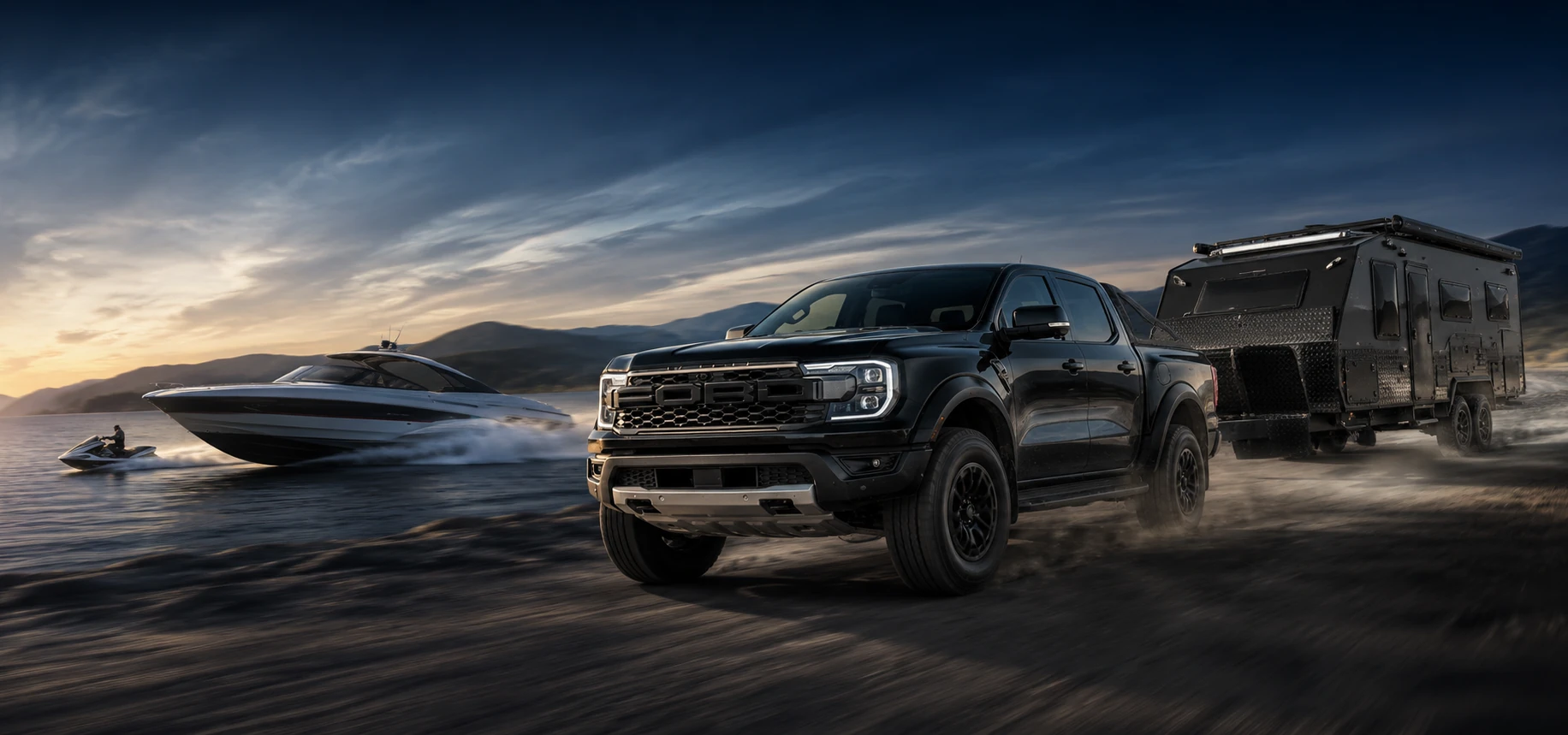
Buying the caravan first and sorting out the tow vehicle afterwards is the most expensive sequence in this whole category. It ends with either a van you cannot legally tow or a five figure vehicle purchase you had not budgeted for.
The frustrating part is that the numbers are all published. They are on plates bolted to the van and the vehicle. They are just written in acronyms that nobody explains properly.
The four numbers that actually decide it
These definitions come from the national vehicle standards, not from forum folklore.
- ATM, Aggregate Trailer Mass. The total maximum mass of the trailer as stated by the manufacturer, together with its load and the mass it imposes on the tow vehicle, with both on a horizontal surface. This is the whole loaded van including what is pressing down on the tow ball.
- GTM, Gross Trailer Mass. The mass transmitted to the ground by the trailer's own axles when it is coupled to the tow vehicle and carrying its maximum load. This is the loaded van excluding what the tow ball is carrying.
- GVM, Gross Vehicle Mass. The maximum laden mass of the fully loaded tow vehicle as specified by its manufacturer. Vehicle, passengers, luggage, accessories, fuel, everything.
- GCM, Gross Combination Mass. The total maximum loaded mass of the tow vehicle and anything it may lawfully tow at any given time. The whole rig together.
Tow ball mass is the difference between two of them
Take ATM and subtract GTM. What is left is the downward force the coupled van puts on the tow vehicle's tow ball. It is not a separate mystery number, it falls straight out of the two definitions above.
This matters more than most buyers realise, because that tow ball mass is carried by the tow vehicle. It counts towards the tow vehicle's GVM and it eats into the vehicle's payload.
That is the trap. A dual cab ute with a headline towing capacity that comfortably covers your van can still be illegal once you load four people, a full tank, a canopy, camping gear and a couple of hundred kilograms of tow ball mass into it. The van was never the problem. The vehicle's payload was.
The two ways people get caught
Assuming maximum tow rating is the whole answer. A vehicle rated to tow a given mass is not necessarily rated to tow it while also carrying a full load of people and gear. GCM is a separate ceiling and it bites first far more often than the tow rating does.
Weighing the van empty. Tare is the van as it left the factory. ATM is what it can weigh loaded. The gap between them is your payload, and water, gas, batteries, an awning, a solar setup and everything you actually pack for a trip goes into it. A van weighed at a public weighbridge fully loaded is the only honest number.
Licence and speed, briefly
For most car and caravan combinations a standard car licence is enough, because the limits that bind are the vehicle's own ratings rather than your licence class. The mass on the tow ball must not exceed the rated capacity of the tow bar and the coupling, the towing mass specified by the vehicle manufacturer, or the GCM shown on the vehicle's registration certificate, whichever is lowest.
Rules differ by jurisdiction beyond that. In NSW, for example, a combination with a GCM over 4.5 tonnes is limited to 100 km/h regardless of the posted limit. Check your own state's requirements rather than assuming the rules travel with you.
Now the finance part: buy the problem in the right order
Once you understand the weights, the financing question becomes obvious. You are not buying a caravan. You are buying a combination, and both halves have to work.
The sensible sequence is:
- Work out the van you actually want, loaded, not tare.
- Establish what tow vehicle that van requires, using GCM and payload rather than the headline tow rating.
- Then work out how to fund whichever pieces you do not already have.
Most people do this backwards, fall in love with a van, and then discover the tow vehicle is a $70,000 problem.
Financing the tow vehicle and the van
There are three realistic structures and they are priced differently.
- A secured car loan for the tow vehicle. The vehicle is the security. This is the cheapest money in the combination, because a late model four wheel drive or ute is exactly the kind of asset lenders like holding. See our car loans page or the car loans guide.
- A secured caravan loan for the van. The van is the security, with the age and condition rules that come with it. Covered in the caravan loans guide.
- An unsecured personal loan for whichever piece does not fit secured policy, most often an older van or an accessory package. Higher cost, far fewer restrictions on what you buy.
There is no rule that says both halves have to come from the same lender or the same product. Frequently the best outcome is a secured loan on the vehicle and a separate arrangement on the van.
What you do want to avoid is applying five times to find out. Each application leaves an enquiry on your credit file and a cluster of them reads as pressure.
GVM upgrades, and how they get funded
If the vehicle you already own is close but the payload does not work, a GVM upgrade is sometimes the answer. It is an engineered modification that raises the vehicle's rated gross vehicle mass, usually through suspension and certification.
Two things worth knowing. First, a GVM upgrade does not automatically raise GCM, so it may not increase what you can tow, only what you can carry. Second, the cost is a modification rather than an asset purchase, so it generally will not be funded by a secured vehicle loan on its own. An unsecured personal loan is the usual route, or rolling it into the finance at the point you buy the vehicle.
Get the engineering advice before the finance advice on that one. There is no point funding an upgrade that does not solve your problem.
Do the sums before you shop
Two numbers are worth writing down before you look at a single van.
- The tow vehicle's GCM, minus the vehicle's actual loaded weight with your family and gear in it. That is your real towing headroom.
- The vehicle's payload, minus your gear, minus the tow ball mass of the van you are considering. If that goes negative, the combination does not work no matter what the tow rating says.
If either number is uncomfortable, the answer is a different van or a different vehicle, and it is much cheaper to learn that now.
One application, the right lenders
Combination purchases are exactly where a broker earns their keep, because you are often coordinating two different products with different policies and different timing.
Loanseekers compares more than 70 lenders across both vehicle and caravan finance, so the structure gets worked out before anything hits your credit file. Start at the caravan loans page, or model the repayments on both halves with our calculator.